
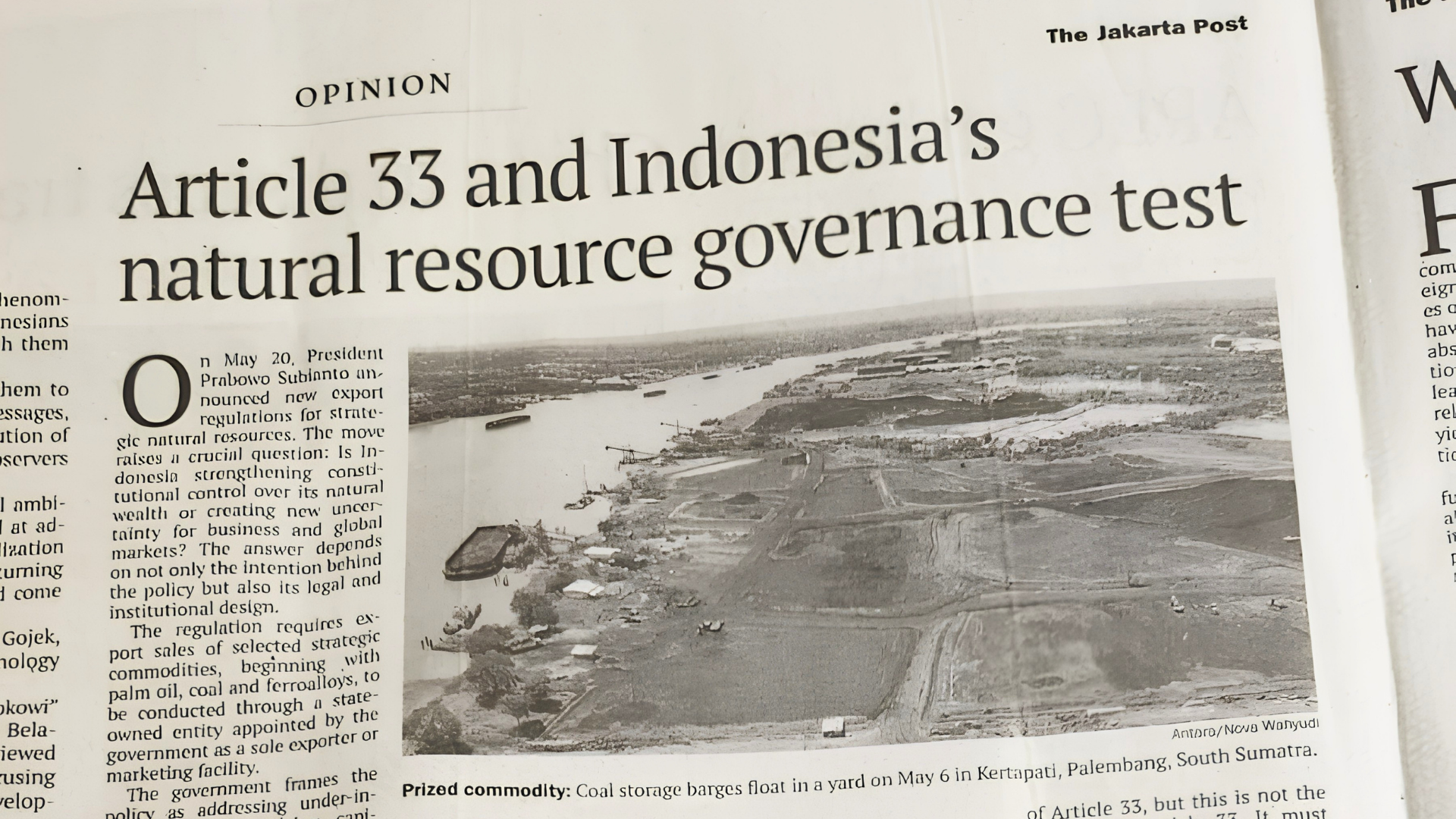
Article 33 and Indonesia's natural resource governance test
Sat, May 23, 2026 - The Jakarta Post On May 20, President Prabowo Subianto announced new export regulations for strategic natural resources. The move raises a crucial question: Is Indonesia strengthening constitutional control over its natural wealth or creating new uncertainty for business and global markets? The answer depends on not only the intention behind the policy but also its legal and institutional design.
Indonesias new export regulations on natural resources is a test of governance that draws upon a constitutional provision that mandates their use to ensure the prosperity of its citizens.
Sat, May 23, 2026 - Fritz Edward Siregar (The Jakarta Post)
On May 20, President Prabowo Subianto announced new export regulations for strategic natural resources. The move raises a crucial question: Is Indonesia strengthening constitutional control over its natural wealth or creating new uncertainty for business and global markets? The answer depends on not only the intention behind the policy but also its legal and institutional design.
The regulation requires export sales of selected strategic commodities, beginning with palm oil, coal and ferroalloys, to be conducted through a state-owned entity appointed by the government as a sole exporter or marketing facility.
The government frames the policy as addressing under-invoicing, transfer pricing, capital flight and lost state revenue. Danantara Sumber Daya Indonesia will reportedly take on this role. Before full implementation, exporters must report essential trade data. Reuters has noted that Danantara will honor existing export contracts, although pricing may be reviewed to ensure alignment with global market levels.
From the perspective of global markets and Indonesias trading partners, the policy can be read in two ways.
If it is poorly explained or implemented, the policy may be seen as unpredictable resource nationalism: state intervention that disrupts contracts, slows export transactions, erodes market trust and increases regulatory risk.
If it is designed transparently and implemented with legal certainty, the policy may strengthen export governance, ensure fair reporting of export values and prevent the leakage of public revenue.
This is where Article 33 of the 1945 Constitution becomes central. Paragraph (3) of the article provides that land, water and the natural resources contained therein shall be controlled by the state and used for the greatest prosperity of the people.
This provision is not merely an economic slogan but part of Indonesias constitutional architecture. It reflects the founders concern that political independence would be incomplete if strategic economic resources remained concentrated in the hands of a few.
This spirit was captured by the old elucidation of the Constitution, which prioritized social prosperity over individual prosperity, and by founding father Mohammad Hattas idea of economic democracy.
This constitutional background matters, because the phrase controlled by the state is often misunderstood. It does not necessarily mean that the state must directly operate every economic activity. But it also does not mean that the state may simply issue permits, collect taxes and wait for reports after transactions have taken place.
The Constitutional Court has provided important guidance. In several landmark decisions, it has interpreted state control under Article 33 as including policymaking, regulation, administration, management and supervision. In its decisions on electricity, BP Migas (the precursor to SKK Migas) and water resources, the court makes clear that private participation is not automatically unconstitutional, and that the state must retain effective control over sectors and resources that affect the livelihood of the people. The thread running through these cases is clear: Article 33 requires effective state control, not merely formal state presence through contracts, licenses or administrative reports.
In the context of strategic commodity exports, this means the state cannot be satisfied with merely issuing export permits. It must also have the capacity to monitor volume, price, buyers, destination, export proceeds, the fairness of reported values and the broader public benefit of the transaction.
If the state lacks visibility over these points, then its control remains incomplete. The state may be present in documents but absent from the economic value chain.
This is why under-invoicing is not merely a technical customs problem. In the context of strategic natural resources, it may become a constitutional governance problem. If export values are reported below their actual market value, the state may lose tax revenue, foreign exchange proceeds and the ability to ensure that natural wealth serves public prosperity.
Joseph E. Stiglitzs warning about the resource curse is relevant here: Natural wealth can become a curse when weak institutions, rent seeking, fiscal leakage and opacity prevent resource value from becoming public welfare. Article 33 can be understood as Indonesias constitutional response to that danger: the state must be present so that natural wealth does not become private rent or hidden value leakage.
But Article 33 is not a blank check. A stronger state role must still remain subject to the rule of law. The concerns of business actors should not be dismissed as resistance to the Constitution. Their concerns point to real requirements of accountable state control: respect for existing contracts, credible pricing standards, fast administrative services, clear payment mechanisms, channels for review, auditability and institutional transparency.
This is especially important if Danantara Sumber Daya Indonesia becomes the implementing vehicle for the new export governance mechanism. A state-owned or state-controlled entity can serve as an instrument of Article 33, but this is not the purpose of Article 33. It must prove that its role improves transparency, prevents under-invoicing, strengthens public revenue and does not create bureaucratic rent seeking.
For trading partners, the message must be clear: Indonesia is not closing itself off from global trade, nor should this policy be framed as hostility toward legitimate business. The constitutional argument is that exports of strategic natural resources must be governed in a way that ensures fair value reporting, proper foreign exchange flows and public benefit. That is different from arbitrary protectionism.
The success of the policy will depend on whether the government can turn constitutional authority into trusted governance. If the new mechanism is transparent, legally clear, fast, auditable and consistent with global market benchmarks, it may strengthen Indonesias bargaining position while maintaining confidence among investors and trading partners.
But if it becomes opaque, slow or unpredictable, it will undermine market trust and weaken the constitutional legitimacy of the policy itself.
Indonesia does not need a passive state in natural resource governance, nor does it need an unaccountable state. It needs a capable constitutional state that is strong enough to prevent the loss of national resource value but is disciplined enough to act through law, transparency and institutional accountability. Natural resources should not leave the country without their value being properly captured for the Indonesian people.
Yet state control must also be controlled by law. That is the real test of Article 33.